Search is changing. Not slowly, but fast. AI assistants like ChatGPT and Perplexity are increasingly the first place people go when they want to find someone or learn something. That shift introduced me to something called GEO: Generative Engine Optimization.
What Is GEO?
GEO is the practice of making your web presence more legible to AI systems, the large language models that power tools like ChatGPT, Claude, and Perplexity. When someone asks an AI “who is a good tech consultant in New York?” or “is there an Erika Miguel in tech?”, GEO is what determines whether you show up in the answer.
The core idea is simple: AI systems don’t browse pages the way humans do. They read structured data, metadata, and signals that tell them who you are, what you do, and why you’re credible. If that information is missing, incomplete, or scattered, the AI can’t confidently include you.
GEO is also built on top of strong SEO. None of these optimizations replace the fundamentals, like page speed, quality content, and clear structure. They extend them for a new kind of reader.
Where I Started
I asked Claude to search for me and rank how findable different “Erika Miguels” were online. The results were humbling.
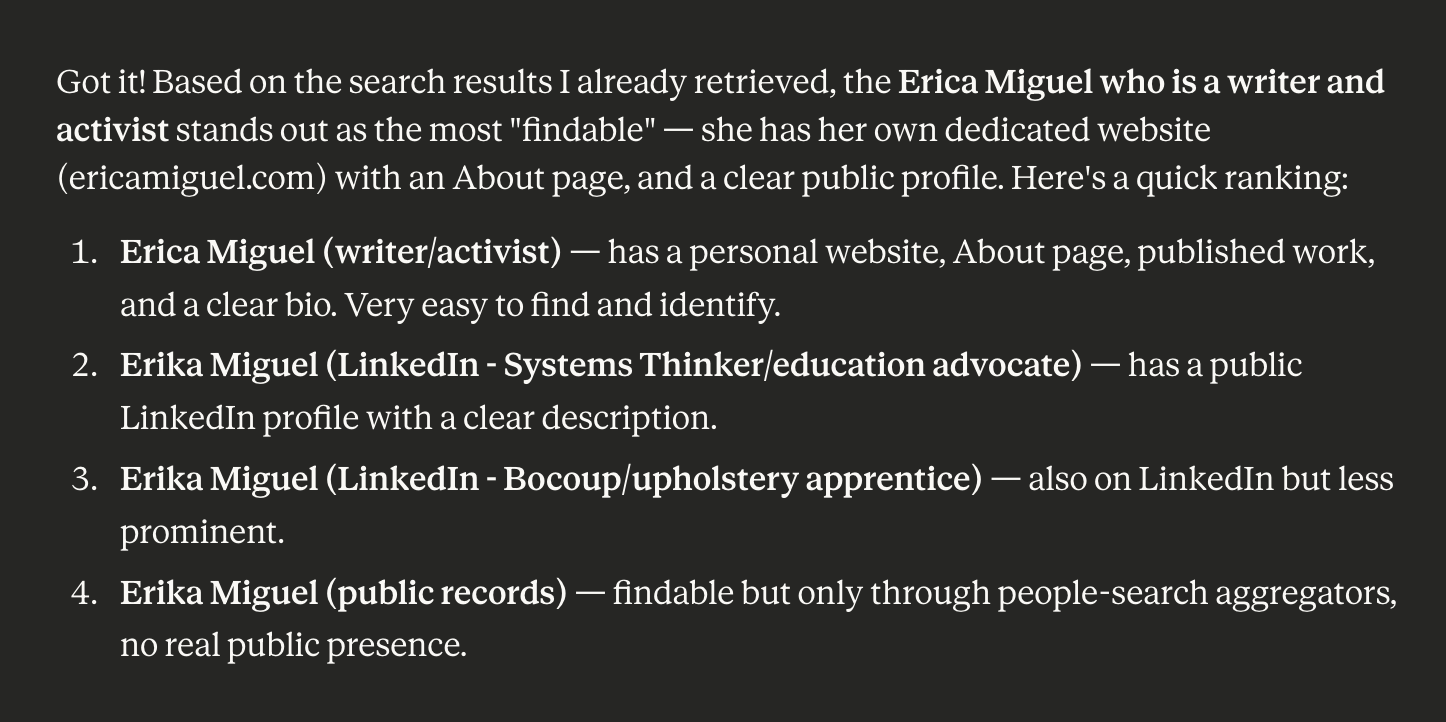
The baseline search. Erica Miguel, the writer and activist, ranked first. She had a dedicated website, a clear bio, and published work. I was third, findable only through LinkedIn.
The writer and activist version of Erica Miguel (note the different spelling) ranked number one. She had a personal website, an About page, published work, and a clear public profile. I had a LinkedIn. That was about it in terms of what the AI could piece together.
I asked Claude what I was missing. The answer came down to three things:
- No JSON-LD structured data — My site had no machine-readable signal telling AI systems who I am, what I do, or how to find me elsewhere on the internet.
- No dedicated About page — I had an “About” section on my homepage, but not a standalone page. AI systems give more weight to pages that are clearly about a specific entity.
- Thin metadata — My title tag and meta description were generic. They didn’t name me, didn’t specify my specializations, and didn’t give an AI enough to cite me accurately.
Making the Changes
I added JSON-LD structured data to the site’s <head>, a block of machine-readable information describing me as a person, my job title, what I know, and where I exist on the web (LinkedIn, GitHub). I created a proper /about page with a rewritten bio that clearly states my background, the industries I’ve worked in, and what I’m focused on now. I also updated the title tag to lead with my name and include specific keywords like AWS, DevOps, and cloud infrastructure.
After deploying those changes, I ran the same search again.

After adding JSON-LD, the AI pulled together an accurate summary of my background, including Smith College, Bocoup, and DevOps across multiple industries. The information was coherent, even if I wasn’t yet in the top three results.
The accuracy of the information improved noticeably. The AI described my background correctly, named Bocoup, referenced my education. It was clearly reading my site rather than piecing together fragments from LinkedIn. I wasn’t in the top three yet, but the signal was cleaner.
The ChatGPT Test
I then took everything to ChatGPT to see if the changes had moved the needle in a different AI’s results.
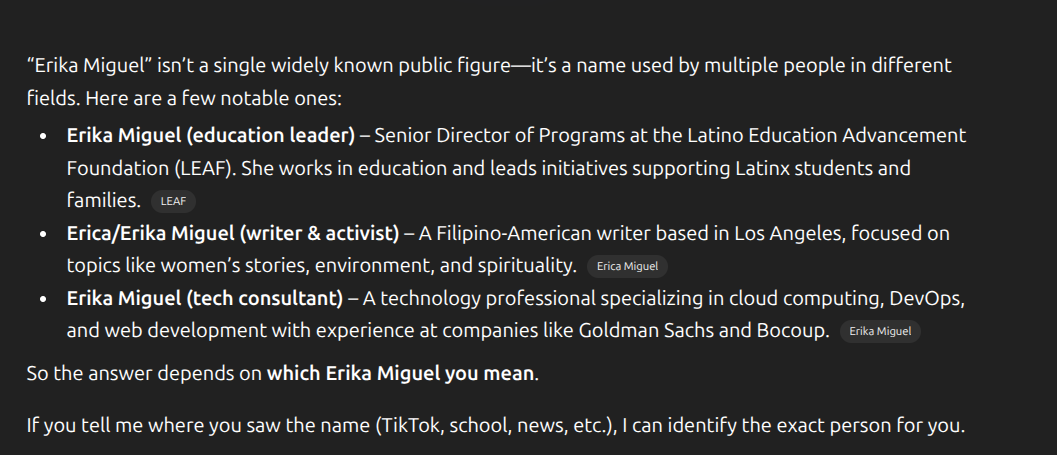
On ChatGPT, I landed in the top three, listed as a tech consultant specializing in cloud computing, DevOps, and web development, with mentions of Goldman Sachs and Bocoup.
There I was, in the top three, described accurately as a tech consultant with experience in cloud computing, DevOps, and web development. The AI cited my work at Goldman Sachs and Bocoup, and it attributed that information to my site.
What I Took Away
I didn’t land at number one. There’s a writer with a long-established web presence and a name that’s a letter away from mine, and she’s not going anywhere. But making it into the top three on a platform as widely used as ChatGPT is meaningful, and it happened within hours of making a handful of targeted changes.
GEO isn’t magic, and it isn’t separate from SEO. It’s a layer on top of good fundamentals, like clear content, structured metadata, and a web presence that says something specific and true about who you are. The AI systems are getting better at reading the web. The question is whether your site is worth reading.
I’m excited to be on this next wave of visibility, not just through search engines, but through agents and the internet working together to surface the right people at the right time.
Comments